One Piece Card Centering: How to Check It and What PSA, BGS and TAG Need
How to measure One Piece card centering on leaders, characters, alt-arts and manga rares, plus the PSA, BGS, CGC and TAG tolerances for a 10.
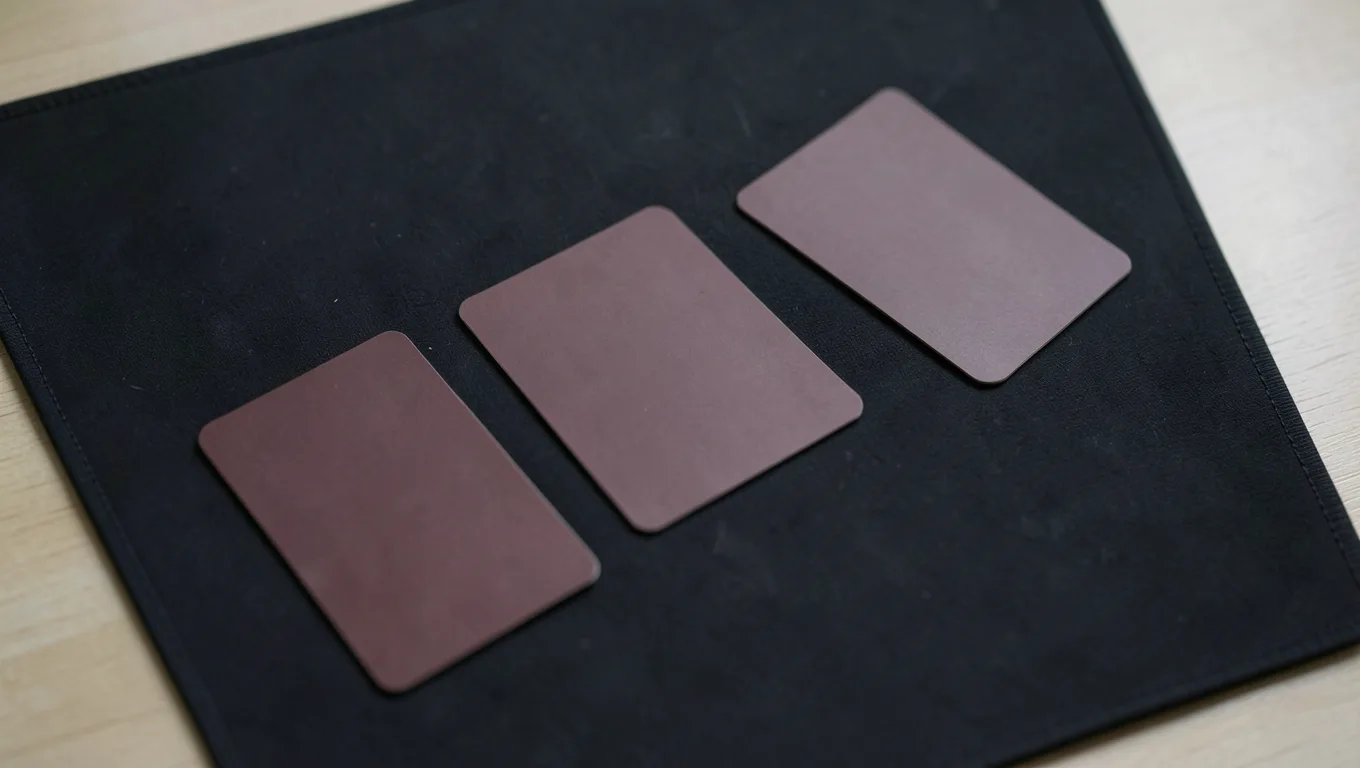
To check centering on a One Piece card, measure from the cut edge to the same printed reference on each opposite side (the thin frame line around the art window for left/right, the top of the art frame and the bottom of the text box for top/bottom), do it at two points per side, then compute the larger border divided by the sum: 2.1 mm ÷ (2.1 + 1.7) = 55%, so 55/45. Flip the card and measure the narrow border around the dark back field the same way. The worst single axis, front or back, is the number that counts.
For the top grades, the published tolerances are: PSA 10 front within approximately 55/45, back within 75/25; BGS 9.5 front 55/45 both ways, back 60/40, and BGS 10 Pristine front 50/50, back 55/45; TAG Gem Mint 10 front ~55/45, back ~65/35 for TCG, and TAG Pristine 10 front ~51/49, back ~52/48 for TCG; CGC Gem Mint 10 front approximately 55/45, back 75/25. Those apply to a One Piece card exactly as they apply to a baseball card; none of the graders publish a One Piece-specific rule.
The reason One Piece gets its own guide is the frame. The cards are not white-bordered, leaders are printed sideways, and alt-arts and manga rares have no frame at all. Where you put the reference line decides what number you get, so the sections below cover each card type, the back, the tolerances per grader, and a photo protocol that keeps the measurement honest.
The One Piece card layout and why it complicates centering
A standard One Piece card (character, event or stage) is a portrait 2.5 × 3.5 in (63.5 × 88.9 mm) card with a colored frame that runs to the cut edge, an art window bounded by a thin frame line, the cost circle in the upper corner, and a text box across the lower portion that carries the name, effect text, power and attribute elements. The frame color follows the card's color identity (red, green, blue, purple, black, yellow or a split).
Three things about this design affect centering work:
- There is no white outer border. On a sports card you measure from the card edge to the white border's inner edge. On a One Piece card the colored frame is the border, and its outer edge is the cut edge. So the reference has to be an inner printed line: the art window frame or the edges of the text box.
- The frame is colored and often foil-treated on parallels. A shifted frame on a high-contrast red or black card is visible from across the room, which is why a 58/42 One Piece card can look worse than a 58/42 white-bordered card even though the number is the same.
- Leader cards are landscape. The layout is rotated 90 degrees, so the long axis of the card is horizontal when you read it. The math does not care, but your labeling does: decide once whether you report "left/right" relative to the card's physical long side or relative to the artwork, and be consistent on the front and back.
Where to put your reference lines, card type by card type
| Card type | Left/right reference | Top/bottom reference | Notes |
|---|---|---|---|
| Character / event / stage (standard frame) | Thin frame line around the art window, measured to the cut edge | Top line of the art frame to top edge; bottom edge of the text box to bottom edge | Use the same line on both sides; do not mix art frame on one side with text box on the other |
| Leader (landscape) | Same inner frame line, with the card rotated so the art reads upright | Same as above, rotated | Measure along the card's physical axes; label them clearly |
| Parallel / alt-art with partial frame | Whatever frame line survives, measured on both sides | Text box bottom to edge; name plate or cost circle top to edge if no frame | More discretion; confirm with the back |
| Manga rare / borderless special art | No frame: cut edge to fixed elements (cost circle, power, name plate) | Same | Compare with certified examples; treat your number as an estimate |
| DON!! cards | Frame line around the central emblem | Same | Rarely graded, same method |
The core rule is one the grading companies' own descriptions imply: BGS defines centering as "the alignment of the card within its borders," and PSA says it "determines centering by comparing the measurements of the borders from left to right and top to bottom." On a card without a literal border, the closest thing to a border is the outermost continuous printed line, and that is what you measure to. None of the major graders has published a One Piece-specific or full-art-specific measuring rule; the "measure to consistent design elements and compare with graded examples" approach is how collectors commonly understand it, not an official statement.
If the art frame line and the text box give you different ratios on the same axis, that usually means the print is slightly tilted or the card has a mild diamond cut. Measure at two points per side (near each corner) to see it. The full-art and borderless measuring guide goes deeper on reference choice, three-border cards and comparing against certified examples.
The back: a narrow border that tells the truth
One Piece backs are the same on every card: a dark printed field framed by a narrow lighter border running around all four edges. That narrow border is your back reference. Measure from the cut edge to the edge of the dark field on the left and right, then top and bottom.
Because the border is narrow, small absolute errors become big ratio swings. On a border that averages about 1.5 mm per side, a 0.25 mm difference between opposite sides is a 54/46 ratio (1.625 ÷ 3.0); a 0.75 mm difference is 62/38 (1.875 ÷ 3.0). That is why collectors report One Piece backs failing 10-grade back tolerances more often than fronts, and why the back deserves the same two-points-per-side treatment.
Back tolerances per grader for the top grades (official figures):
| Grader | Top grade | Back limit | Next grade | Back limit |
|---|---|---|---|---|
| PSA | 10 Gem Mint | 75/25 | 9 Mint | 90/10 |
| BGS | 10 Pristine (Gold or Black) | 55/45 | 9.5 Gem Mint | 60/40 |
| BGS | 9 Mint | 70/30 | 8 NM/MT | 80/20 |
| CGC | Gem Mint 10 | 75/25 | 9 Mint | 90/10 (stated for sports and non-sports cards) |
| TAG | 10 Pristine | ~52/48 (TCG) | 10 Gem Mint | ~65/35 (TCG) |
| TAG | 9 Mint | ~75/25 (TCG) | 8.5 NM-MT+ | ~85/15 (TCG) |
| SGC | 10 Pristine / 10 Gem | not published | 9 Mint | not published |
TAG is the one to watch here. Its rubric publishes a TCG-specific back tolerance that is tighter than its sports figure at the same grade (~65/35 vs ~70/30 for Gem Mint; ~52/48 vs ~54.5/45.5 for Pristine). A One Piece back at 70/30 is inside PSA's 10 line but outside TAG's Gem Mint line. The background on why backs are treated differently, and how each grader handles them, is in does back centering matter.
Front tolerances per grader, applied to a One Piece card
| Grader | Grade | Front tolerance (official) | Back (official) |
|---|---|---|---|
| PSA | 10 Gem Mint | approx. 55/45 | 75/25 |
| PSA | 9 Mint | approx. 60/40 | 90/10 |
| PSA | 8 NM-MT | approx. 65/35 | 90/10 |
| BGS | 10 Pristine | 50/50 all around | 55/45 |
| BGS | 9.5 Gem Mint | 55/45 both ways | 60/40 |
| BGS | 9 Mint | 55/45 both ways | 70/30 |
| BGS | 8 NM/MT | 60/40 both ways | 80/20 |
| CGC | Pristine 10 | 50/50 | not stated |
| CGC | Gem Mint 10 | approx. 55/45 | 75/25 |
| TAG | 10 Pristine (990–1000) | ~51/49 | ~52/48 (TCG) |
| TAG | 10 Gem Mint (950–989) | ~55/45 | ~65/35 (TCG) |
| TAG | 9 Mint (900–949) | ~60/40 | ~75/25 (TCG) |
| SGC | 10 Pristine / 10 Gem | 50/50 / 55/45 | not published |
Two details matter for One Piece submitters. BGS writes "both ways" for 9.5 and 9, meaning both the left/right and the top/bottom axes must be inside 55/45, and BGS 9 carries the same 55/45 front limit as 9.5; the difference at 9 is the looser 70/30 back and the other subgrades. TAG's help pages say a Pristine 10 front "generally cannot exceed a single measurement of 51/49," which is the clearest official statement that each axis is judged on its own and the worst one governs. PSA says the same thing in its own words: centering is "the percent of difference at the most off-center part of the card."
The complete ladder for every grader, including the mid grades, is in the card centering tolerance table by grade. For TAG's 1000-point bands and the eight-subgrade DIG report, see TAG grading centering explained.
Worked examples on real One Piece measurements
Character card, standard frame. Left frame line to edge: 2.0 mm and 2.1 mm at the two measuring points, average 2.05. Right: 2.5 mm and 2.4 mm, average 2.45. Total 4.50 mm; 2.45 ÷ 4.50 = 54.4% → 54/46. Top art frame to edge 2.8 mm, text box bottom to edge 3.3 mm; 3.3 ÷ 6.1 = 54.1% → 54/46. Front is inside PSA 10, CGC Gem Mint 10, BGS 9.5, SGC 10 Gem and TAG Gem Mint, but not BGS 10, CGC Pristine, SGC Pristine or TAG Pristine. Now the back: left 1.3 mm, right 1.9 mm; 1.9 ÷ 3.2 = 59.4% → 59/41. That back is inside PSA 10 (75/25) and TAG Gem Mint TCG (~65/35), inside BGS 9.5 (60/40) by less than a point, and outside BGS 10 (55/45). The card's realistic ceiling is PSA 10 / CGC 10 / TAG Gem Mint / BGS 9.5, not a Black Label.
Leader card, landscape. Rotate the card so the art reads upright. Along the long physical axis (now your left/right): 1.7 mm vs 2.6 mm → 2.6 ÷ 4.3 = 60.5% → 60/40. Along the short axis: 2.2 mm vs 2.3 mm → 51/49. Worst axis 60/40: that is PSA 9 territory (approx. 60/40 or better), a BGS 8 front (60/40 both ways), a TAG 9 Mint front (~60/40). It misses every company's top grade on centering alone, and no amount of corner or surface quality changes that.
Manga rare, no frame. Cut edge to the cost circle's outer edge on the left versus cut edge to a fixed element at the same height on the right is not a like-for-like pair, so you cannot build a clean ratio. What you can do: measure the back precisely, measure the gap from each edge to the text box on the front (that box is still rectangular and centered in the design), and compare the front with a few certified 10s of the same card. Report your result as "roughly 56/44 by the text box, back 53/47" and accept that a grader's judgment will carry more weight here than on a framed card.
Set-to-set centering: what collectors report
There is no official, per-set centering data from any grading company for One Piece, and this article will not invent any. What can be said, clearly labeled:
- Collectors report that centering quality varies noticeably by print wave, with some early English print runs and some starter deck cards more often shifted than later reprints.
- Collectors report that Japanese printings are frequently better centered than their English counterparts, which mirrors the broader TCG pattern where thin-bordered Japanese cards also look better at the same ratio.
- Collectors report that back centering is a common reason otherwise clean One Piece cards miss the top grade.
Treat all three as reputation, not measurement. The only number that matters for your card is the one you take from it.
How to measure a One Piece card step by step
- Take the card out of the sleeve or toploader. Plastic adds glare and can hide a hairline of frame.
- Lay it flat on a matte, contrasting surface. A dark card on a dark desk makes edge detection harder; use a light neutral background for dark frames and a dark one for light frames.
- Shoot straight down, or scan. A phone held at an angle foreshortens one side and can move the ratio several points. A flatbed scan at 600 dpi is the most repeatable method.
- Pick your reference pair per axis (art frame line for left/right, art frame top and text box bottom for top/bottom) and measure at two points per side. Average each side.
- Compute larger ÷ (larger + smaller) × 100 for each axis. Write it as larger/smaller, e.g. 56/44.
- Flip the card and repeat on the back border.
- Record the worst axis front and the worst axis back. That pair is your centering profile.
- Compare to the tables above, or let the free card centering calculator do it: place the guide lines on the frame lines in your photo and it computes the ratios and maps them to the PSA, BGS, CGC, SGC and TAG standards.
For the general technique (caliper, pixel counting, scanner settings, and how much error each method adds) see how to measure card centering at home.
Foil, parallel and glare tips
- On foil parallels the frame line can reflect and blur in a photo. Tilt the light, not the card, until the line is a crisp edge, then shoot straight down.
- Use the back to sanity-check the front. The back border is matte on most printings and gives a clean, high-contrast measurement; if the back reads 52/48 but your front reads 62/38 on the same axis, re-check your front reference before trusting it.
- Do not measure through a penny sleeve, and never through a toploader. A 0.25 mm error on a 2 mm frame is roughly a six-point swing in the ratio.
- Measure before you buy, not just before you submit. A raw One Piece card at 60/40 is a 9 ceiling at PSA, and you should pay a 9 price for it.
Bottom line
- Measure from the cut edge to the same printed reference on both sides of each axis: art frame line for left/right, art frame top and text box bottom for top/bottom; rotate leaders and measure the same way.
- Top-grade fronts: PSA 10 approx. 55/45; BGS 9.5 55/45 both ways and BGS 10 50/50; CGC Gem Mint 10 approx. 55/45; TAG Gem Mint ~55/45 and Pristine ~51/49; SGC Gem 55/45 and Pristine 50/50.
- Backs differ more than fronts: PSA 75/25, BGS 9.5 60/40 and BGS 10 55/45, TAG TCG ~65/35 Gem and ~52/48 Pristine, CGC 75/25; SGC publishes none.
- The narrow back border and colored front frame make One Piece centering easy to see and easy to mis-measure; use two points per side, straight-down photos or scans, and the worst axis governs.
- Alt-art and manga rares have no frame; measure fixed elements and the back, compare to certified examples, and expect grader discretion.
Frequently asked questions
What centering does a One Piece card need for a PSA 10?
PSA's published Gem Mint 10 standard applies to One Piece cards like any other: the front must be centered within approximately 55/45 and the back within 75/25. A PSA 9 allows approximately 60/40 on the front and 90/10 on the back. Measure both axes, front and back; the worst single measurement is the one that counts against the standard.
Where do you measure centering on a One Piece card?
Measure from the cut edge of the card to the same printed reference on each opposite side. On a standard character, event or stage card that is usually the thin frame line around the art window for left and right, and the top of the art frame and bottom of the text box for top and bottom. On leader cards the layout is landscape, so rotate the card and measure the same way. Always use the same reference on both sides of an axis.
How do you measure centering on One Piece alt-art and manga rare cards?
Borderless alt-arts and manga-style parallels have no frame to measure, so graders are commonly understood to judge the cut against consistent printed elements such as the name plate, cost circle, power value and text box, and to compare the card with known graded examples. Measure the back, which keeps its normal design, and measure the distance from each edge to a fixed element on the front. Expect more grader discretion on these cards.
Does back centering matter on One Piece cards?
Yes, and it is often the axis that costs a 10. PSA allows 75/25 on the back for a 10 and 90/10 for a 9. BGS requires 55/45 on the back for a Pristine 10 and 60/40 for a 9.5. TAG's TCG back limits are about 52/48 for Pristine and about 65/35 for Gem Mint. One Piece backs have a narrow border around a dark printed field, so an off-center back is easy to see and easy to measure.
What is the difference between PSA, BGS and TAG centering rules for One Piece?
PSA 10 is approximately 55/45 front and 75/25 back. BGS 9.5 Gem Mint is 55/45 both ways on the front and 60/40 on the back, while BGS 10 Pristine is 50/50 front and 55/45 back. TAG Gem Mint 10 is about 55/45 front and about 65/35 back for TCG, and TAG Pristine 10 is about 51/49 front and about 52/48 back for TCG. CGC Gem Mint 10 matches PSA at approximately 55/45 front and 75/25 back.
Are One Piece cards usually well centered?
Centering varies by set and print run. Collectors report that some early English printings and certain starter deck cards run off-center more often than later waves, and that Japanese printings are frequently better centered, but there is no official set-level data. Treat every card as unknown until you measure it. A measurement takes a minute and is the only pre-grading check you can reduce to a number.